Burntide Official Website › Ingredients
Burntide Ingredients: The Full List, Blend and Minerals
Burntide is made with apple cider vinegar, BHB calcium, BHB magnesium and BHB sodium in a single 525 mg blend.
Three minerals are also listed at 0% of the Daily Value. The label shows the blend total rather than each amount, and this page prints it that way.
Compare with the full facts panel.
Eleven items appear on the Burntide label between the Supplement Facts panel and the other-ingredients line. Every one of them is below, with what is published, what is not, and what the research used.
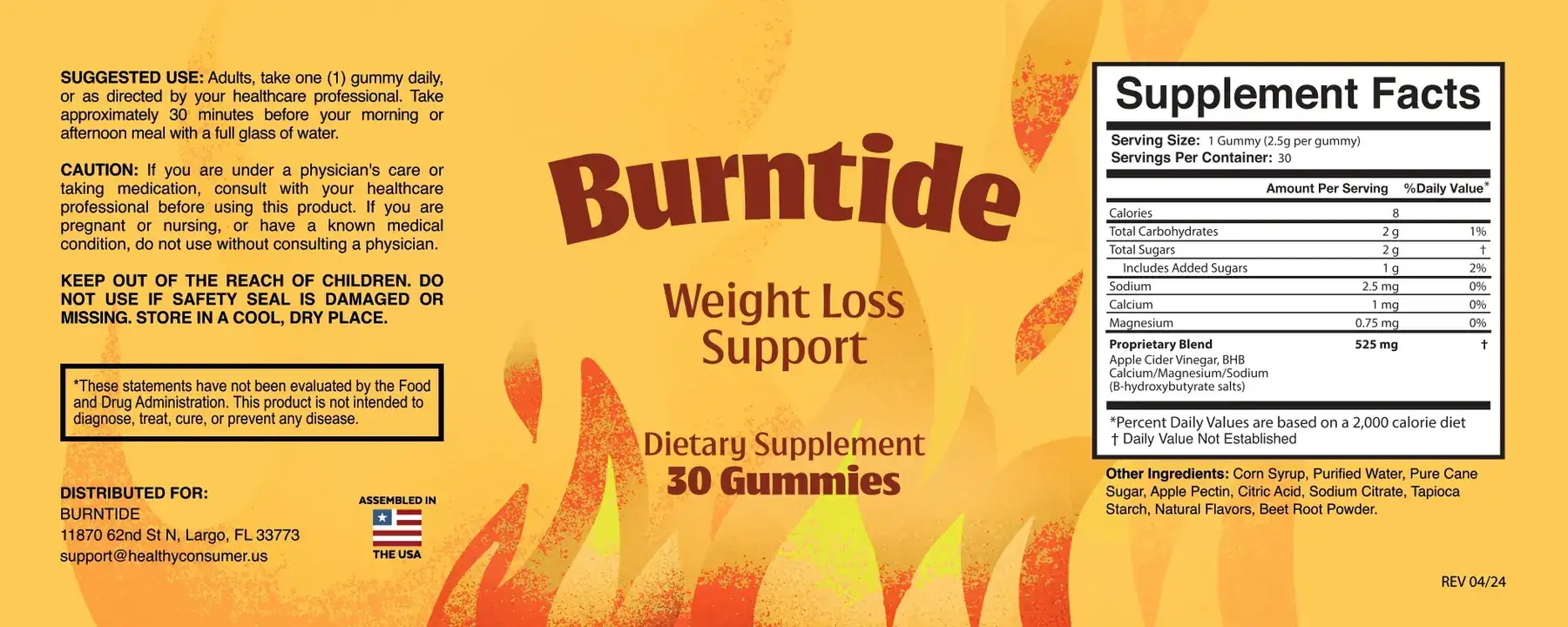
What is on the Burntide label, in one screen
If you read nothing else on this page, read these four lines.
- ›Four items sit inside the blend. Apple cider vinegar, BHB calcium, BHB magnesium and BHB sodium, declared together at 525 mg.
- ›Three minerals are declared separately. Sodium 2.5 mg, calcium 1 mg, magnesium 0.75 mg. All three round to 0% of the Daily Value.
- ›Nine items form the gummy itself. Corn syrup, Purified water, Pure cane sugar, Apple pectin, Citric acid, Sodium citrate, Tapioca starch, Natural flavors, Beet root powder.
- ›One figure is missing and it is the important one. How the 525 mg divides between four ingredients is not disclosed anywhere.
How to read the Burntide blend without guessing
The order ingredients appear in is not decoration. The FDA labelling guide requires ingredients inside a proprietary blend to be listed in descending order of predominance by weight, so the panel's sequence tells you the ranking even when it withholds the amounts. On this label the sequence is apple cider vinegar, then BHB calcium, then BHB magnesium, then BHB sodium.
That gives you three facts for free. Apple cider vinegar is the largest single component of the blend. Every other component is smaller than it. And the total of all four is 525 mg, which is 21% of the 2.5 g gummy by weight, with the rest being sugar, water, pectin, starch and flavour.
It does not tell you whether the vinegar is 60% of the blend or 30% of it. A formula could put 400 mg of vinegar against 125 mg of BHB salts, or 150 mg against 375 mg, and print exactly the same panel. Both are legal. Only one of them is what is in the jar, and the label does not say which.
Why this desk will not estimate the split. We could publish a plausible-looking breakdown and nobody would catch it. It would also be fiction, and once a website has printed one number it did not have, no other number on it can be trusted. Every figure on this site is either on the panel, in a cited paper, or marked “not published”.
Every Burntide ingredient, one at a time
Eleven entries, in the order the label prints them. The blend items come first, then the separately declared minerals, then the base.
Apple Cider Vinegar
Not published Named first in the blendApple cider vinegar is fermented apple juice, and the component the research cares about is acetic acid. It is the first item named inside the proprietary blend, which by the labelling convention the FDA sets out means it is present in the largest amount of the four. It does not mean it is most of the blend, and the label does not say how much of the 525 mg it accounts for. Evidence. Kondo 2009 is the trial most often cited for vinegar, a twelve-week study in obese Japanese adults. Johnston 2004 reported improved insulin sensitivity to a high-carbohydrate meal, Ostman 2005 reported lower glucose and insulin responses with higher reported satiety after a bread meal, and Hlebowicz 2007 looked at gastric emptying. a 2025 dose-response meta-analysis pooled the controlled trials in type 2 diabetes and graded the certainty of the evidence, which is a more useful read than any single study. The caveat that matters more than any of them. Every one of those trials used liquid vinegar at tablespoon doses, roughly 750 to 1,500 mg of acetic acid a day. The entire blend in this gummy is 525 mg, shared with three other ingredients, and only a fraction of any vinegar solid is acetic acid to begin with. the 2020 systematic review covers the safety literature and the limits of the evidence in full.
BHB Calcium
Not published Calcium beta-hydroxybutyrateBeta-hydroxybutyrate is a ketone body. Your liver makes it from fat when glucose is scarce, and it is a fuel your brain and muscle can burn. A BHB salt pairs that molecule with a mineral so it can be handled as a dry powder. The calcium form is the most common of the three. Evidence. Stubbs 2017 measured what actually happens to blood ketones after people drink exogenous ketones, and it is the paper to read if you want to know what these ingredients do rather than what they are marketed as. Newman and Verdin 2017 is a signalling review: BHB is not only fuel, it also acts on gene expression. the 2022 Sports Medicine review reviews the athletic literature. The dose problem, stated plainly. Those studies used ketone esters or multi-gram salt drinks, typically 10 to 25 g, enough to move blood ketone concentration measurably. Burntide's whole blend is 525 mg, and the calcium declared on the panel is 1 mg, which is 0% of a Daily Value. A serving of this gummy will not put anybody into ketosis and this website does not suggest otherwise.
BHB Magnesium
Not published Magnesium beta-hydroxybutyrateThe same ketone body paired with magnesium instead of calcium. Salt manufacturers blend the three mineral forms partly for taste and partly to keep any single mineral load down, since a full ketone-salt dose delivers a great deal of mineral alongside the ketone. Evidence. Evans 2017 explains how ketone bodies are metabolised during exercise and why exogenous supplementation was proposed in the first place. Soto-Mota 2019 followed healthy adults taking ketone monoester drinks for 28 days and reported on tolerability, which is the sort of question worth asking of any ingredient sold for daily use. Magnesium on this label. 0.75 mg per gummy, 0% of the Daily Value. For context, the ODS magnesium fact sheet puts the adult requirement in the region of 310 to 420 mg a day. This is not a magnesium supplement and nothing here should be read as one.
BHB Sodium
Not published Sodium beta-hydroxybutyrateThe third salt form. Sodium is the mineral most people are already getting too much of, so it is the one worth checking on any ketone product. What this label declares. 2.5 mg of sodium per gummy, 0% of the Daily Value. the CDC puts average American intake above 3,300 mg a day against a 2,300 mg target, so a single gummy is not going to matter either way. It is a fact worth printing anyway, because full-dose ketone salt powders genuinely can carry a meaningful sodium load and buyers who have been told to watch sodium deserve the number rather than a reassurance. the FDA on sodium explains how to read the figure on any label.
Calcium
1 mg Declared separately on the panelThe panel lists calcium on its own line as well as inside the blend name, and the figure is 1 mg, which rounds to 0% of the Daily Value. the ODS calcium fact sheet puts the adult requirement between 1,000 and 1,200 mg a day. A gummy contributing one thousandth of that is a consequence of the salt form, not a calcium supplement, and the label does not claim it is one.
Magnesium
0.75 mg Declared separately on the panelSame story as the calcium. 0.75 mg is 0% of the Daily Value and arrives as part of the magnesium BHB salt rather than as an added mineral. If magnesium is what you are after, the ODS magnesium fact sheet lists food sources and the supplement forms that carry a meaningful dose.
Sodium
2.5 mg Declared separately on the panel2.5 mg per gummy, 0% of the Daily Value, arriving with the sodium BHB salt and the sodium citrate in the base. Negligible against a daily intake measured in thousands of milligrams. Printed here because a ketone product should always show its sodium.
Corn syrup and pure cane sugar
2 g sugars The two sweetenersA gummy has to taste like a gummy, and these are what do it. The panel puts total sugars at 2 g per gummy with 1 g of that added, and the whole gummy at 8 calories. That is a small number in absolute terms and it is still the honest reason a chewable is not the same product as a capsule. If you are counting sugar for any reason at all, count this one.
Apple pectin and tapioca starch
Not published What sets the gummyPectin is fruit fibre and it is why this gummy sets without gelatin, which is what makes the vegetarian mark on the jar possible. Tapioca starch controls the texture. Neither is an active and neither is doing anything the supports on the label describe.
Citric acid and sodium citrate
Not published Acidity and preservationThe pair that balances the sweetness and keeps the gummy stable on a shelf. Citric acid is the sharpness you taste. It is worth saying plainly that citric acid is not apple cider vinegar and does nothing that acetic acid has been studied for, because the tartness of a chewable is easy to mistake for the vinegar doing something.
Natural flavors and beet root powder
Not published Taste and colourBeet root powder is the colourant, which is why the gummies in the jar photograph are red rather than the amber the listing artwork shows. “Natural flavors” is a category the FDA permits on a label without naming the individual compounds, so nobody outside the manufacturer knows precisely what is in it. the FDA labelling guide sets out what a label has to disclose and what it does not.
The three Burntide ingredient pictures, explained

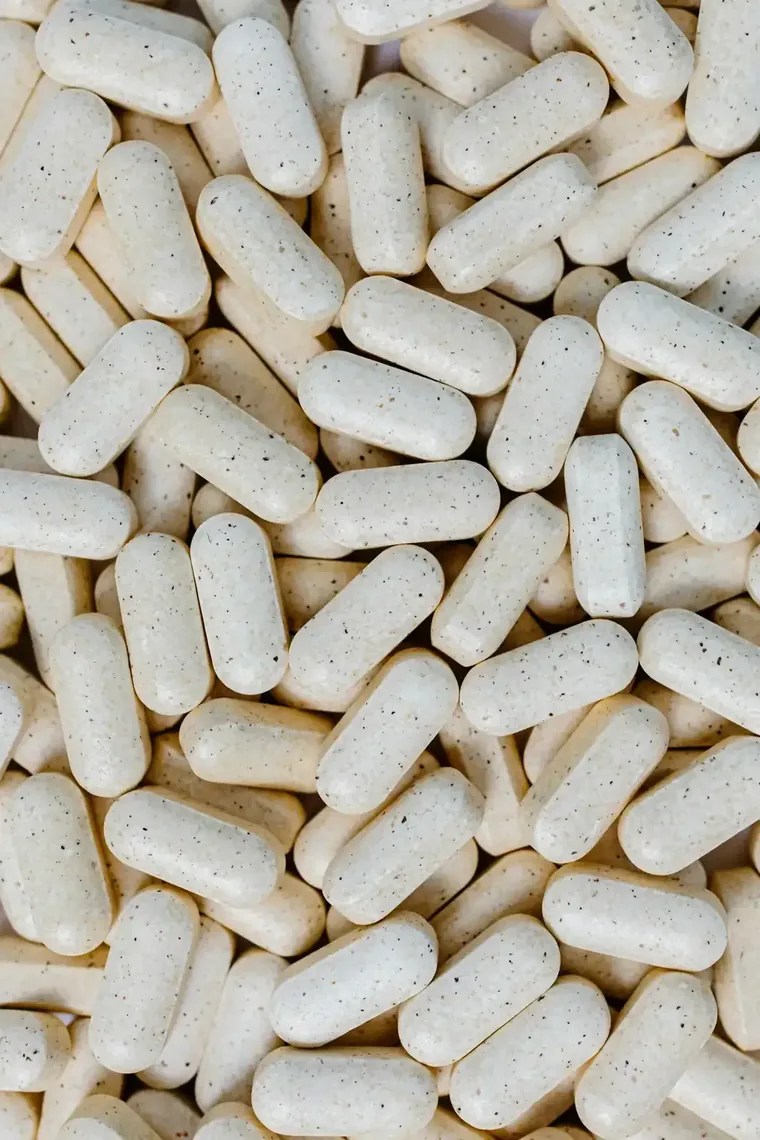

Burntide ingredient amounts against the research
| Ingredient | On the Burntide label | Amount used in the cited research | Ratio |
|---|---|---|---|
| Apple cider vinegar | Inside 525 mg, split not published | 15 to 30 ml liquid vinegar daily | The whole blend is a fraction of one dose |
| BHB salts, combined | Inside the same 525 mg | 10 to 25 g per drink | Roughly 20 to 50 times the entire blend |
| Calcium | 1 mg | 1,000 to 1,200 mg a day | About one thousandth |
| Magnesium | 0.75 mg | 310 to 420 mg a day | About one five-hundredth |
| Sodium | 2.5 mg | Target intake 2,300 mg a day | Negligible |
The right-hand column is the one that matters and it is the one most pages in this category leave out. It does not prove the ingredients do nothing. It proves that the published work cannot be used to predict what this amount does, because nobody has tested this amount. The ODS fact sheet on weight-management supplements makes the same point across the whole category.
What the Burntide base ingredients are doing
The nine base ingredients are not filler in the pejorative sense. A chewable has to set, stay set on a shelf, taste of something and survive shipping, and each of these does one of those jobs. It is still worth knowing which is which, because a base ingredient list is where the sugar hides.
| Base ingredient | Job it does | Worth knowing |
|---|---|---|
| Corn syrup | Bulk sweetener and texture | Carbohydrate rather than an active |
| Purified water | Solvent everything dissolves into | Ordinary and honest to list |
| Pure cane sugar | Sweetener | Part of the 2 g total sugars |
| Apple pectin | Sets the gummy | Fruit fibre, and why the jar carries a vegetarian mark |
| Citric acid | Acidity and tartness | Not vinegar, and does nothing acetic acid is studied for |
| Sodium citrate | Buffer and preservative | A second small contributor to the 2.5 mg sodium |
| Tapioca starch | Texture control | Keeps the chew consistent across a shelf life |
| Natural flavors | Taste | A permitted collective term; the compounds are not named |
| Beet root powder | Colour | Why the gummies photograph red rather than amber |
One small inconsistency worth flagging, because somebody will notice it: the listing artwork shows amber gummies and the jar photograph shows red ones. Beet root powder is the reason a red gummy is plausible. Marketing renders are not photographs of the batch you receive, and the panel on the jar governs.
What a fully disclosed Burntide label would look like
It is easy to criticise a proprietary blend and harder to say what the alternative looks like. Here is the version of this panel that would answer every question this page has to leave open.
| What a fully disclosed panel would print | What this label prints |
|---|---|
| Apple cider vinegar, 300 mg (an example figure, not this product) | Named first inside a 525 mg blend |
| Calcium BHB, 90 mg (example) | Named second inside the same blend |
| Magnesium BHB, 75 mg (example) | Named third |
| Sodium BHB, 60 mg (example) | Named fourth |
| Acetic acid content of the vinegar solid | Not stated |
| Whether the vinegar is a powder or a concentrate | Not stated |
| Whether the BHB is the D or the racemic DL form | Not stated |
The last row is the one a specialist would ask about first. Stubbs 2017 found that the two enantiomers of beta-hydroxybutyrate behave differently, and most salt products use the cheaper racemic mixture in which only half is the form the body uses readily. This label does not say which. At 525 mg for the whole blend the question is close to academic, and it is still a question a fully disclosed panel would answer.
What is not in Burntide
Absence is hard to prove from a photograph, so it is worth stating plainly. On the evidence of the printed panel and the other-ingredients line, none of the following is in this product.
- ✓No caffeine, no green tea extract and no other stimulant.
- ✓No garcinia cambogia, no raspberry ketone and no forskolin.
- ✓No gelatin. The gummy sets with apple pectin.
- ✓No dairy, and the jar carries a dairy-free mark.
- ✓No declared gluten source in the base list.
- ✓No prescription or drug ingredient of any kind. If you ever suspect otherwise about any supplement, the FDA publishes a running list of tainted products.
- ✓No vitamin or mineral at a nutritionally meaningful amount. The three minerals declared all round to 0% of the Daily Value.
If an ingredient matters to you medically rather than philosophically, do not take a website's word for it. Photograph the panel on the jar you receive and take it to your pharmacist. That is a five-minute conversation and it is the only version of this check that is actually authoritative.
Burntide ingredient questions
How much apple cider vinegar is in Burntide?
Not published. Apple cider vinegar is the first item named inside a 525 mg proprietary blend, which by the FDA labelling convention means it is present in the largest amount of the four. The label stops there. The only firm statement anybody can make is that it cannot exceed 525 mg.
Is Burntide a keto supplement?
It contains three BHB salts, which are the ingredients keto products are usually built around. It is not a ketogenic aid in any meaningful sense, because the whole blend is 525 mg and the trials that move blood ketones used 10 to 25 grams. Nothing on this website suggests it induces ketosis.
Does Burntide contain caffeine or a stimulant?
No stimulant appears anywhere on the panel or in the other-ingredients line. The complete list is apple cider vinegar, three BHB salts, corn syrup, purified water, pure cane sugar, apple pectin, citric acid, sodium citrate, tapioca starch, natural flavors and beet root powder.
Is Burntide vegetarian and gluten free?
The jar carries vegetarian, gluten-free, non-GMO and dairy-free marks. The gummy is set with apple pectin rather than gelatin, which is what makes the vegetarian mark possible. Check the panel on the jar you receive, which is the version that governs.
What are the natural flavors in Burntide?
Not published, and that is normal rather than evasive. The FDA labelling guide permits a manufacturer to group flavour compounds under that heading without naming them. If you have a flavour sensitivity, the order desk on +1 (631) 016-1313 can put the question to the manufacturer.
Which ingredient has the strongest evidence behind it?
Apple cider vinegar, comfortably. It has two decades of small human trials and a 2025 dose-response meta-analysis behind it. The catch is in the phrase "dose-response": the effect tracks the amount, and the amounts studied were tablespoons of liquid vinegar rather than a fraction of a half-gram blend.
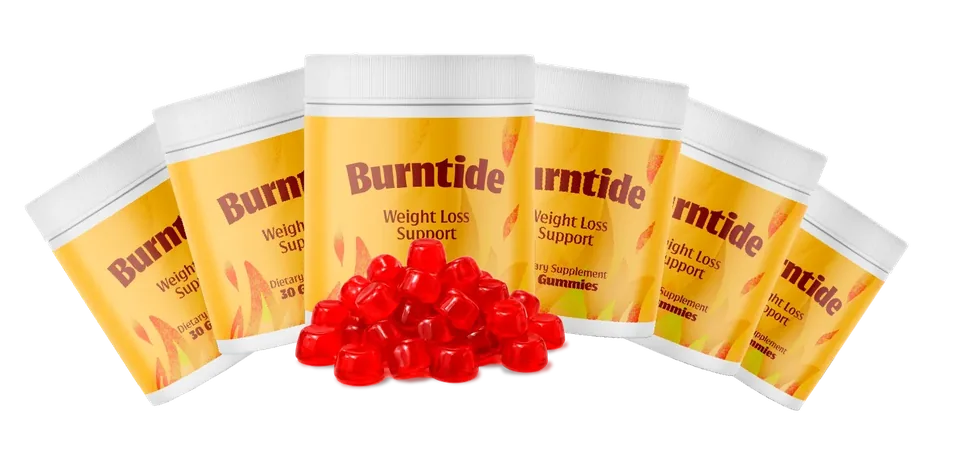
Order Burntide on the official website.
One gummy a day, 30 to a jar, with the panel above printed on every one. Sixty days to change your mind.
Price and pack sizes are shown on the checkout page
Order Burntide On The Official WebsiteOne gummy a day · 30 per jar · 60-day money-back guarantee · lot BUR-26/BU-7406
References behind this Burntide page
Every source below was opened and checked. None of them studied Burntide itself; they concern the ingredients, at the amounts the researchers used.
- Kondo T, Kishi M, Fushimi T, Ugajin S, Kaga T. Vinegar intake reduces body weight, body fat mass, and serum triglyceride levels in obese Japanese subjects. Biosci Biotechnol Biochem. 2009;73(8):1837-43. PMID 19661687. https://pubmed.ncbi.nlm.nih.gov/19661687/
- Johnston CS, Kim CM, Buller AJ. Vinegar improves insulin sensitivity to a high-carbohydrate meal in subjects with insulin resistance or type 2 diabetes. Diabetes Care. 2004;27(1):281-2. PMID 14694010. https://pubmed.ncbi.nlm.nih.gov/14694010/
- Ostman E, Granfeldt Y, Persson L, Bjorck I. Vinegar supplementation lowers glucose and insulin responses and increases satiety after a bread meal in healthy subjects. Eur J Clin Nutr. 2005;59(9):983-8. PMID 16015276. https://pubmed.ncbi.nlm.nih.gov/16015276/
- Hlebowicz J, Darwiche G, Bjorgell O, Almer LO. Effect of apple cider vinegar on delayed gastric emptying in patients with type 1 diabetes mellitus: a pilot study. BMC Gastroenterol. 2007;7:46. PMID 18093343. https://pubmed.ncbi.nlm.nih.gov/18093343/
- Arjmandfard D, Behzadi M, Sohrabi Z, et al. Effects of apple cider vinegar on glycemic control and insulin sensitivity in patients with type 2 diabetes: a GRADE-assessed systematic review and dose-response meta-analysis of controlled clinical trials. Front Nutr. 2025;12:1528383. PMID 39949546. https://pubmed.ncbi.nlm.nih.gov/39949546/
- Launholt TL, Kristiansen CB, Hjorth P. Safety and side effects of apple vinegar intake and its effect on metabolic parameters and body weight: a systematic review. Eur J Nutr. 2020;59(6):2273-2289. PMID 32170375. https://pubmed.ncbi.nlm.nih.gov/32170375/
- Stubbs BJ, Cox PJ, Evans RD, et al. On the metabolism of exogenous ketones in humans. Front Physiol. 2017;8:848. PMID 29163194. https://pubmed.ncbi.nlm.nih.gov/29163194/
- Newman JC, Verdin E. Beta-hydroxybutyrate: a signaling metabolite. Annu Rev Nutr. 2017;37:51-76. PMID 28826372. https://pubmed.ncbi.nlm.nih.gov/28826372/
- Evans M, McClure TS, Koutnik AP, Egan B. Exogenous ketone supplements in athletic contexts: past, present, and future. Sports Med. 2022;52(Suppl 1):25-67. PMID 36214993. https://pubmed.ncbi.nlm.nih.gov/36214993/
- Evans M, Cogan KE, Egan B. Metabolism of ketone bodies during exercise and training: physiological basis for exogenous supplementation. J Physiol. 2017;595(9):2857-2871. PMID 27861911. https://pubmed.ncbi.nlm.nih.gov/27861911/
- Soto-Mota A, Vansant H, Evans RD, Clarke K. Safety and tolerability of sustained exogenous ketosis using ketone monoester drinks for 28 days in healthy adults. Regul Toxicol Pharmacol. 2019;109:104506. PMID 31655093. https://pubmed.ncbi.nlm.nih.gov/31655093/
- National Institutes of Health, Office of Dietary Supplements. Magnesium: Fact Sheet for Health Professionals. https://ods.od.nih.gov/factsheets/Magnesium-HealthProfessional/
- National Institutes of Health, Office of Dietary Supplements. Calcium: Fact Sheet for Health Professionals. https://ods.od.nih.gov/factsheets/Calcium-HealthProfessional/
- Centers for Disease Control and Prevention. About Sodium and Health. https://www.cdc.gov/salt/about/index.html
- U.S. Food and Drug Administration. Sodium in Your Diet: Use the Nutrition Facts Label and Reduce Your Intake. https://www.fda.gov/food/nutrition-education-resources-materials/sodium-your-diet
- U.S. Food and Drug Administration. Dietary Supplement Labeling Guide. https://www.fda.gov/food/dietary-supplements-guidance-documents-regulatory-information/dietary-supplement-labeling-guide
- U.S. Food and Drug Administration. Weight Loss Product Notifications (tainted products marketed as dietary supplements). https://www.fda.gov/drugs/medication-health-fraud/tainted-weight-loss-products
- National Institutes of Health, Office of Dietary Supplements. Dietary Supplements for Weight Loss: Fact Sheet for Health Professionals. https://ods.od.nih.gov/factsheets/WeightLoss-HealthProfessional/

Every page, every journal post, the bottle facts and the ingredients go through review by Dr. Spencer Berry, MD before they ship. We write these pages from the Burntide label, the Supplement Facts panel photographed on the jar, and the distributor’s own paperwork. We cite public research for apple cider vinegar and beta-hydroxybutyrate, and we print “not published” wherever the label withholds a figure rather than estimating it. Where the manufacturer’s own listing artwork claims more than the panel supports, we say so on the page. Corrections are made on the page itself and the review date moves forward. Write to [email protected]. Last reviewed September 2026 by Dr. Spencer Berry, MD.